
An automatic thermostat sounds like a simple upgrade, but in Indian homes it is rarely that simple. Most smart thermostats shown online were built for central heating and cooling, which most Indian flats do not have.
Here are three essential facts before you buy: what the device really does, which type fits a split AC, and where real savings come from.
Quick answer: An automatic thermostat switches cooling or heating on and off to hold a set temperature. For most Indian homes with split ACs, the right smart upgrade is a Wi-Fi IR controller, not a wall thermostat. Savings come mainly from steady schedules, not from the gadget alone.
What Is an Automatic Thermostat and How Does It Work?
An automatic thermostat senses the room temperature and switches a heater or cooler on and off to keep it near your set temperature. It does this without you touching a switch. Basic versions use a simple metal strip, while smart versions add Wi-Fi, schedules and phone control.

A thermostat built around a bimetal strip has been used since the nineteenth century. Two metals bonded together expand at different rates, so the strip bends as the room warms and opens or closes an electrical circuit.
Good thermostats also avoid switching too often. They allow a small gap, usually 1 to 2 °C, between switching on and switching off. This gap is called hysteresis, and it protects compressors from rapid on-off cycling. Many models also include an anticipator, which switches off slightly early so the room does not overshoot your target.
Why Do Western Smart Thermostats Rarely Fit Indian Homes?
Western wall thermostats such as Nest, ecobee and Honeywell are designed for central heating and cooling. One furnace, boiler or ducted unit serves the whole house through a single 24-volt wall control.
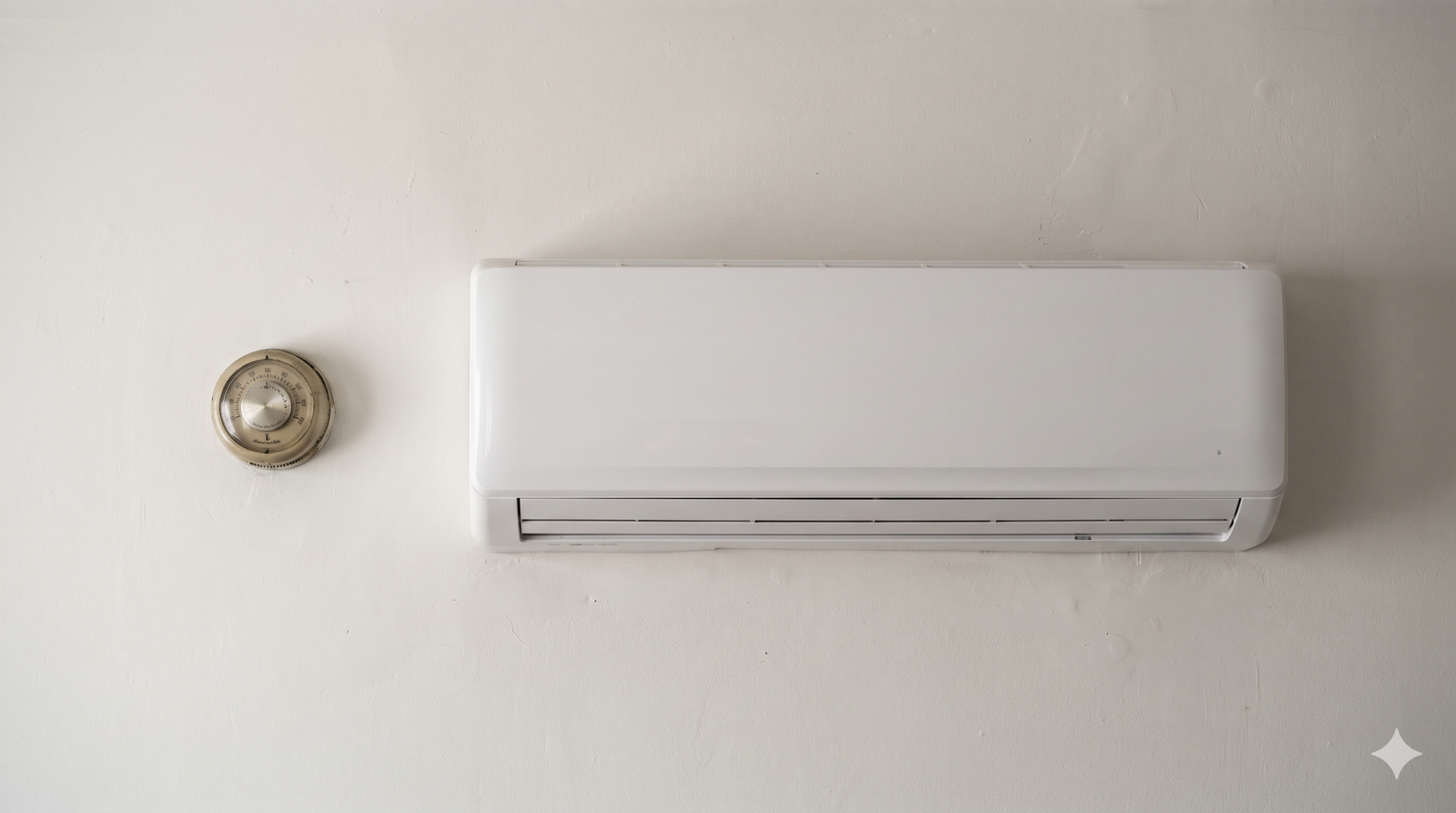
Most Indian homes cool room by room instead. Each split AC has its own compressor and its own infrared remote, so there is nothing for a wall thermostat to wire into. Buying one for a split AC is simply the wrong category of product.
Safety note: Never connect a low-voltage thermostat to a line-voltage circuit, such as a direct-wired electric heater. It can fail and become a fire hazard. Always ask a licensed electrician to check the wiring first.
Which Automatic Thermostat Suits Your Home?
Match the device to your cooling or heating system, not to a brand. This table shows the usual fit.

| Home type | Best fit | Why |
|---|---|---|
| Split or window AC | Wi-Fi IR controller | Copies your remote, no wiring |
| Ducted AC or VRF villa | Wired smart controller | Manages zones from the wall |
| Cold-belt home with boiler or heat pump | Wired smart thermostat | Matches central heating design |
| New build with ducted HVAC | Wired smart thermostat | Wiring can be planned early |
For split ACs, brands such as Sensibo and Cielo make Wi-Fi IR controllers. They learn your original remote’s signals, so they work across many AC brands. You get app control, schedules, geofencing and voice commands without an electrician.
Useful features include 7-day schedules, geofencing that switches the AC off when you leave and pre-cools before you return, and voice control through Alexa, Google Assistant or Siri. These controllers suit ACs that come with a remote, not ducted systems with a hard-wired controller.
- IR controllers: simple and renter-friendly, but one-way. If someone uses the physical remote, the app may not know the AC’s real status.
- Direct-wired adapters: connect to the AC’s control board and report status accurately, but they need a technician.
- Wired smart thermostats: suit ducted or VRF villas, cold-belt homes with boilers or heat pumps, and new builds. Our air source heat pump guide covers the heat pump side.
Is an Automatic Thermostat Worth It for Savings?
It can be, if you run your AC for many hours, but the savings are modest and depend on how you use it. The best-known study is old and from the US, so treat its numbers as a rough guide, not a promise.

That study, run by thermostat software maker EnergyHub across roughly 90 Southern California homes in 2012 and 2013, found an average 6% drop in summer electricity use. August savings reached 17%. Because the company itself ran it, independent research is a useful check. One NBER working paper found that user behavior dampens the savings that engineering models predict.
For Indian homes, the Bureau of Energy Efficiency (BEE) offers a simpler rule. It estimates that each 1 °C rise in AC temperature saves about 6% of electricity, and since 1 January 2020 new room ACs must default to 24 °C. Real savings vary by AC and room, but a schedule that lifts the setpoint by 2 °C after midnight, plus switching off an empty room, targets exactly that gap.
Payback depends on your usage. Prices for IR controllers vary widely by brand, so check current listings before you decide. Savings come from steady schedules, so set them once and avoid constant tweaking.
Choose the Right Automatic Thermostat for Your Home
Start with your cooling system, not the brand. If you have split ACs, a Wi-Fi IR controller is usually the smart fit. Set a simple schedule, leave it alone for a month, and compare your next electricity bill. The first few weeks of use show how your family really lives in each room, so adjust the schedule only after you have seen a full month of data. Small, patient changes usually beat constant fiddling. For more ideas, see our list of smart home devices worth buying.
Frequently Asked Questions
Can I use a Nest or ecobee thermostat with a split AC?
Usually no. These wall thermostats need a central 24-volt system, which most split-AC homes do not have. A Wi-Fi IR controller is the usual choice instead.
What is the difference between an IR controller and a wired smart thermostat?
An IR controller copies your AC remote’s signals and needs no wiring, but it may not see the AC’s true status. A wired smart thermostat connects to the equipment’s controls and suits ducted, VRF or central heating systems.
How much can an automatic thermostat save?
One older US study found about 6% lower summer electricity use on average, and BEE estimates about 6% per degree on AC settings. Your own savings depend on how steadily you use schedules.
1 thought on “Automatic Thermostats Explained: Is a Smart Upgrade Really Worth It for Your Home?”