
A remote fan lets you change speed, set a sleep timer and switch off without leaving your bed. In India, most remote fans are also BLDC fans, and that is where the real electricity saving comes from.
This guide explains whether a remote fan is worth buying, how the remotes work, what a retrofit kit can and cannot do, and how to fix a remote that stops responding.
Quick answer: A remote fan is worth it if it has a BLDC motor and runs many hours a day. BLDC fans draw roughly 28 to 35 watts, against about 70 to 90 watts for older induction fans, so the extra cost can pay back in around one to two years. For a room used an hour or two a day, a regular fan is fine.
Is a Remote Fan Worth It in India?
The big change is the motor. Older fans use induction motors that typically draw 70 to 90 watts. BLDC fans use permanent magnets and a small electronic controller, and typically draw 28 to 35 watts. Most of these fans sold in India are BLDC, so the remote and the saving usually come together.

Here is a simple example. Say a 75-watt fan is replaced by a 30-watt BLDC fan that runs 8 hours a day. That saves about 0.36 units a day, or roughly 130 units a year. At an assumed ₹7 per unit, that is about ₹900 a year. If the BLDC fan costs ₹1,500 more, it pays for itself in under two years. Your tariff and hours of use will change this, so check your own bill.
| Fan type | Typical power | Remote | Best for |
|---|---|---|---|
| Regular induction fan | About 70 to 90 W | Usually none | Guest rooms, storerooms |
| BLDC remote fan | About 28 to 35 W | Built in | Bedrooms and living rooms used 8+ hours |
| Induction fan with retrofit kit | Still about 70 to 90 W | Added by the kit | A cheap remote upgrade |
Does a Low-Watt Fan Give Less Breeze?
Not if it meets the standard. Indian standard IS 374:2019 sets a minimum air delivery of 210 cubic metres per minute for a 1200 mm fan. In a Consumer VOICE lab test of 5-star BLDC fans, every brand met that minimum. Crompton recorded 233.73, Atomberg 228.36 and Orient 224.46 cubic metres per minute.
That test covered specific models, and models change, so check the air delivery on the box. Also look for the BEE star label. A brushless DC motor saves power through better engineering, not weaker airflow.
IR or RF: Which Remote Type Is Better?
Infrared (IR) remotes need a clear line of sight to the fan. Radio frequency (RF) remotes send signals through furniture and blankets, and work from further away, so many people prefer them in bedrooms.

Most remotes offer several speed steps, a sleep timer that lowers the speed before switching off, and a boost mode. Smart fans go further, adding a Wi-Fi app, schedules and voice control through Alexa or Google Assistant, and they cost more. Whichever type you pick, keep fresh batteries in the remote and store it somewhere safe, since replacements can be costly. If you like smart control at home, see our guide to the automatic thermostat too.
Can You Add a Remote to Your Old Fan?
Yes, but only for regular fans. Retrofit kits such as the Usha Aeroswitch are listed as suitable for any fan apart from BLDC fans. The kit is a receiver that fits near the fan and a handheld remote.
A retrofit adds convenience only. It does not cut the power your old fan uses. Also, the old wall regulator must be taken out of the circuit, because a remote controller should not run through it. Ask a qualified electrician to do this work.
What Are the Downsides of Remote Control Fans?
- Higher price: you pay more upfront than for a regular fan.
- Remote replacement: a lost remote can be costly, and universal remotes may not match a BLDC fan’s features.
- Repairs: BLDC fans have an electronic controller, so repairs usually need the brand’s service centre, while a basic induction fan can be fixed by a local electrician.
- Warranty: terms differ between brands, so compare the years offered and check that a service centre exists in your city.
For a guest room used one or two hours a day, a regular fan is the practical choice, because the savings would take many years to cover the higher price.
How Do You Fix a Fan Remote That Stops Responding?
Start with fresh batteries from a sealed pack. A weak battery can still light the remote’s LED but fail to send a signal.
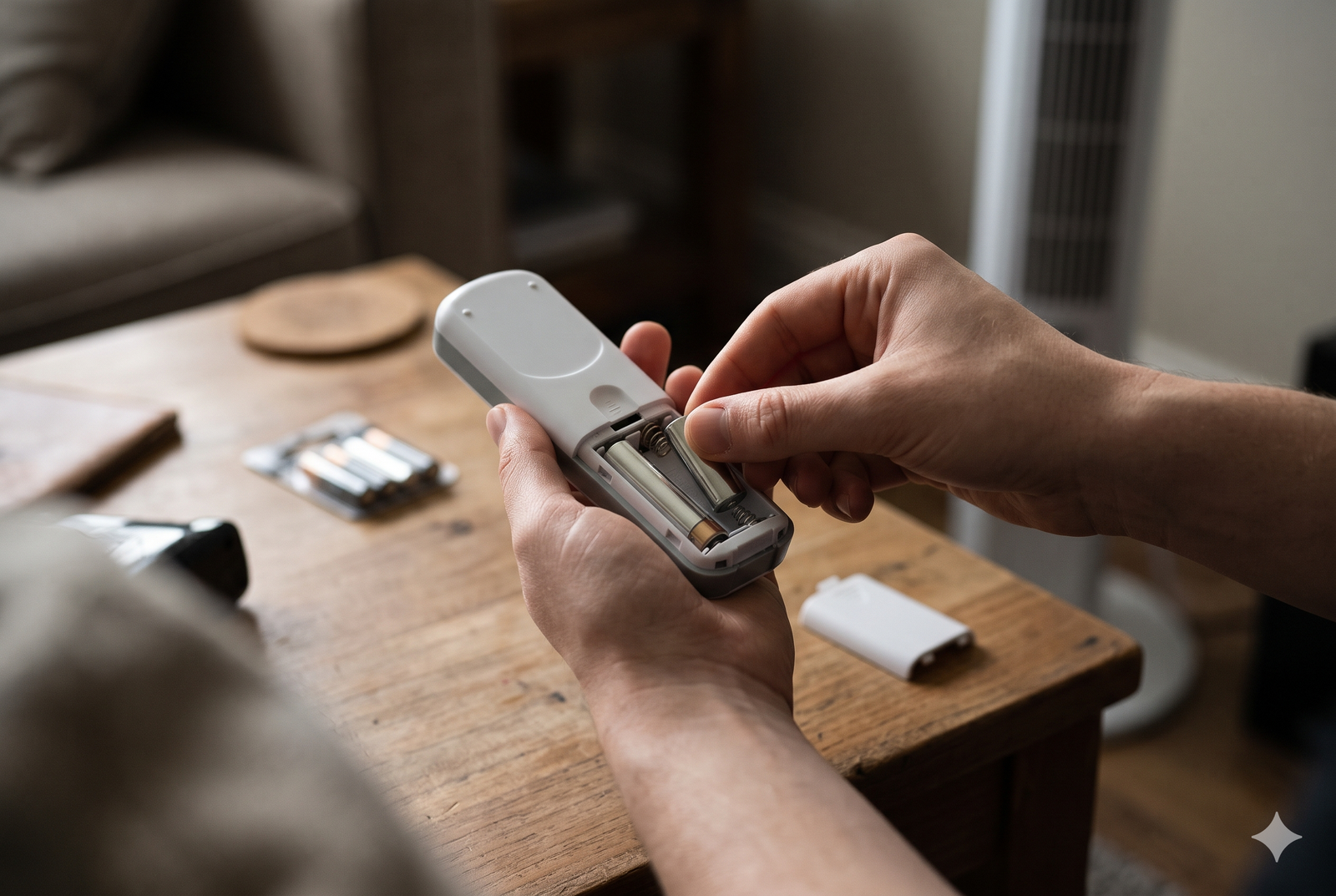
After a power cut or electrical work, the remote may need re-pairing. For many fans, you switch off the wall power for about 10 seconds, switch it on, then press the pairing button as your manual describes. If the fan works from the wall switch but ignores the remote, the remote or its battery is the problem. If the fan does not respond at all or behaves oddly, the receiver in the canopy may have failed. That involves overhead mains wiring, so call a qualified installer.
A remote fan is a smart buy when it is a BLDC model and runs most of the day. Check the air delivery, compare warranty terms, and pick RF if you want to control it from bed. For another way to trim cooling costs, read about a thermostat for your AC unit.
Frequently Asked Questions
Is a remote fan worth buying in India?
It is worth it if the fan has a BLDC motor and runs many hours a day, because BLDC fans draw roughly 28 to 35 watts against about 70 to 90 watts for older fans. For rooms used an hour or two daily, a regular fan is fine.
Can I add a remote to my old ceiling fan?
Yes, if it is a regular induction fan. Retrofit kits like the Usha Aeroswitch are listed as suitable for any fan except BLDC fans, and an electrician should fit them.
Why is my fan remote not responding?
Try fresh batteries first. If the fan works from the wall switch, re-pair the remote after a power cut as your manual describes. If it does not respond at all, the receiver may have failed and needs a qualified installer.