
The best bassinet is the one that meets federal safety rules, fits right beside your bed and suits your budget. Fancy features come second, because a flat, firm sleep space is what matters most for a newborn.
Here is what to look for, which models US parents talk about most, and the safety mistakes that are easy to make when you are tired.
Quick answer: The best bassinet for most US families is a flat, firm model with a sturdy stand and sides at least 7.5 inches high. Parents often praise the HALO BassiNest for bedside use, the Newton for breathability and the Chicco LullaGlide for value. Check the current price and recall status before you buy.
What Makes the Best Bassinet Safe?
The best bassinet has a firm, flat surface, a stand, sides of at least 7.5 inches and nothing inside except a fitted sheet. It should meet the federal standard from the US Consumer Product Safety Commission (CPSC). Those basics matter more than any app or motion setting.

The American Academy of Pediatrics (AAP) advises sharing a room with your baby for at least the first 6 months, but never the same bed. A bassinet makes that easier because it is small enough to keep your baby within reach at night.
Federal rules also help you tell a real sleep product from a risky one:
- Age rule: Any product marketed for sleep for babies up to 5 months must meet a federal sleep standard.
- Angle: The sleep surface must be 10 degrees or lower.
- Stand and sides: Flat products covered by the rule need a stand and sides at least 7.5 inches high.
- Inclined sleepers: These are banned under federal law. Do not use one, even if it is a hand-me-down.
If a product has no stand and is meant to sit on a bed or floor, be careful. The CPSC has warned parents to stop using some baby loungers for exactly that reason.
Which Bassinets Do Parents Recommend?
Parents usually recommend the HALO BassiNest for bedside access, the SNOO for automatic soothing, and the Newton for its breathable mattress. No single model is the best bassinet for everyone. These picks are not ranked, so match them to your room, your recovery and your budget.

| Bassinet | Good for | Keep in mind |
|---|---|---|
| HALO BassiNest | Bedside access and C-section recovery | Heavy base, not portable |
| Happiest Baby SNOO | Automatic soothing | A big investment, and babies may need weaning off motion |
| UPPAbaby Soma | Custom motion settings | Uses a Bluetooth app |
| Cradlewise | Longer use, as it converts to a crib | A premium purchase |
| Newton Bassinet | Breathable, washable mattress | No automatic motion |
| Chicco LullaGlide | Value, with gliding and portable modes | Check the limits in the manual |
Bedside Comfort: HALO BassiNest
The swivel arm moves the sleep area toward your bed, and the push-down side means less bending and twisting. That is why many parents recovering from a C-section like it. The heavy base is the main trade-off, and its legs can get in the way in a small bedroom.
One caution: Consumer Reports has told parents not to buy or use the separate HALO BassiNest Flex portable model, because its tests found it tilts to one side.
Automatic Soothing: Happiest Baby SNOO
The SNOO responds to fussing with white noise and gentle motion. In 2023 the FDA authorized it to help keep babies sleeping on their backs. The FDA has not authorized it to prevent SIDS.
In 2026 the company recalled its extra-small and extra-large SNOO Sacks after an FDA warning letter. If you use a SNOO, stick to the small, medium and large sacks. Follow the current instructions from the company.
Simple and Budget-Friendly Picks
You do not need smart features for a safe bassinet. The Newton has a washable mattress and mesh walls. Newton also sells a simpler Essential version. The Chicco LullaGlide can stay still, glide, or lift off its stand as a portable sleep surface. For a playard option, the Graco Pack ‘n Play Close2Baby adds a bassinet insert. Shop around, since our guide to shopping smarter online applies to baby gear too.
Bedside Sleepers
A bedside sleeper has a drop-down side and straps that attach to your bed. Your baby stays on a separate flat surface, which suits night feeds. Always attach it when the side is down, and check that it suits your bed height. The CPSC has recently recalled several bedside sleepers, so search its site for the exact model first.
What Safety Mistakes Should You Avoid?
The biggest mistakes are making the bassinet feel cozier and letting a baby sleep in gear that was not made for sleep. Even the best bassinet stops being safe when soft items go inside. Your baby should sleep alone, on their back, on a firm, flat mattress with a fitted sheet.
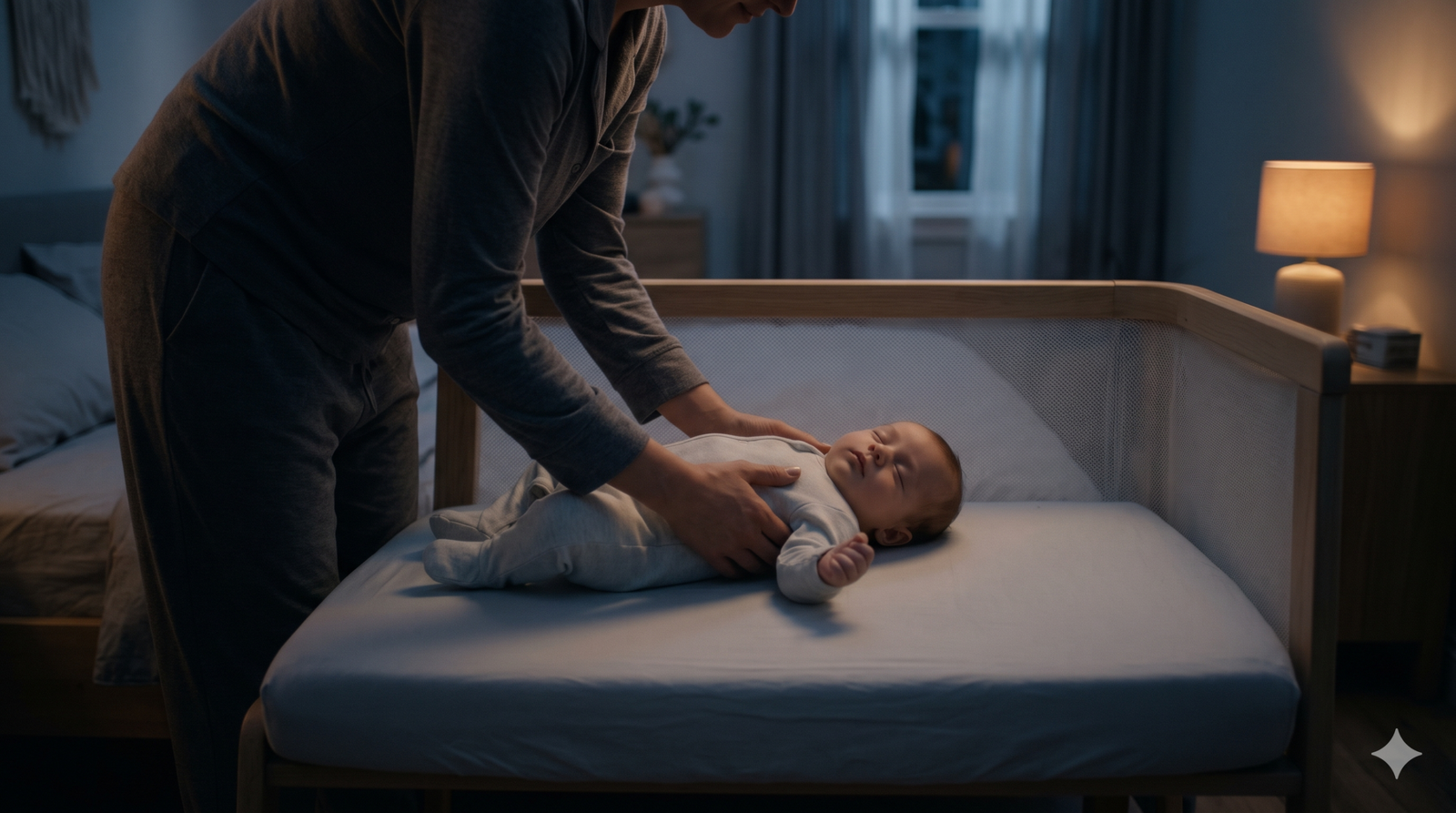
Avoid these common slips:
- Adding pads, toppers, pillows, blankets or toys
- Using bumpers, which the AAP says to keep out and federal law bans in cribs
- Letting a baby stay asleep in a swing or car seat. Move them to a firm sleep surface as soon as you can
- Using loungers, nests or in-bed sleepers that do not meet federal standards
- Dressing your baby too warmly. One more layer than you are wearing is enough
A bare bassinet can feel empty, but that is how it should look. The same idea of keeping spaces simple and clear works well here.
When Should Your Baby Stop Using a Bassinet?
Stop using a bassinet when your baby reaches the weight limit or starts rolling, pushing up or sitting, whichever comes first. Big numbers on the box can mislead you. Developmental milestones usually end bassinet use well before the weight limit does, because a mobile baby could fall over the low sides.

Moving to a crib is easier with a little planning:
- Set up the crib early, with a firm, tight-fitting mattress and a fitted sheet.
- Keep it in your room at first, so the space still feels familiar.
- Stay consistent and try not to switch back and forth.
For travel, follow the same rules. Portable bassinets like the Chicco LullaGo have limits of their own, so read the manual. With any travel crib or playard, secure the mattress straps or clips so no gaps form around the edges.
Choose Safety First, Then Comfort
The best bassinet for your family keeps your baby close on a flat, firm, bare surface. Pick the features you truly need, then look up that exact model on the CPSC recall site before you buy. Speak to your pediatrician if you have any questions about safe sleep.
Frequently Asked Questions
How long can a baby sleep in a bassinet?
Until your baby reaches the weight limit or starts rolling, pushing up or sitting, whichever comes first. Milestones usually come before the weight limit.
Is a bassinet safer than a crib?
Not by itself. Both are safe sleep spaces when they meet federal standards and hold only a firm mattress and fitted sheet. A bassinet simply takes up less room beside your bed.
Can I add a soft pad to make a bassinet cozier?
No. Pads, toppers, pillows, blankets and toys can create suffocation and entrapment risks. Use only the firm mattress that fits the bassinet and a fitted sheet.