
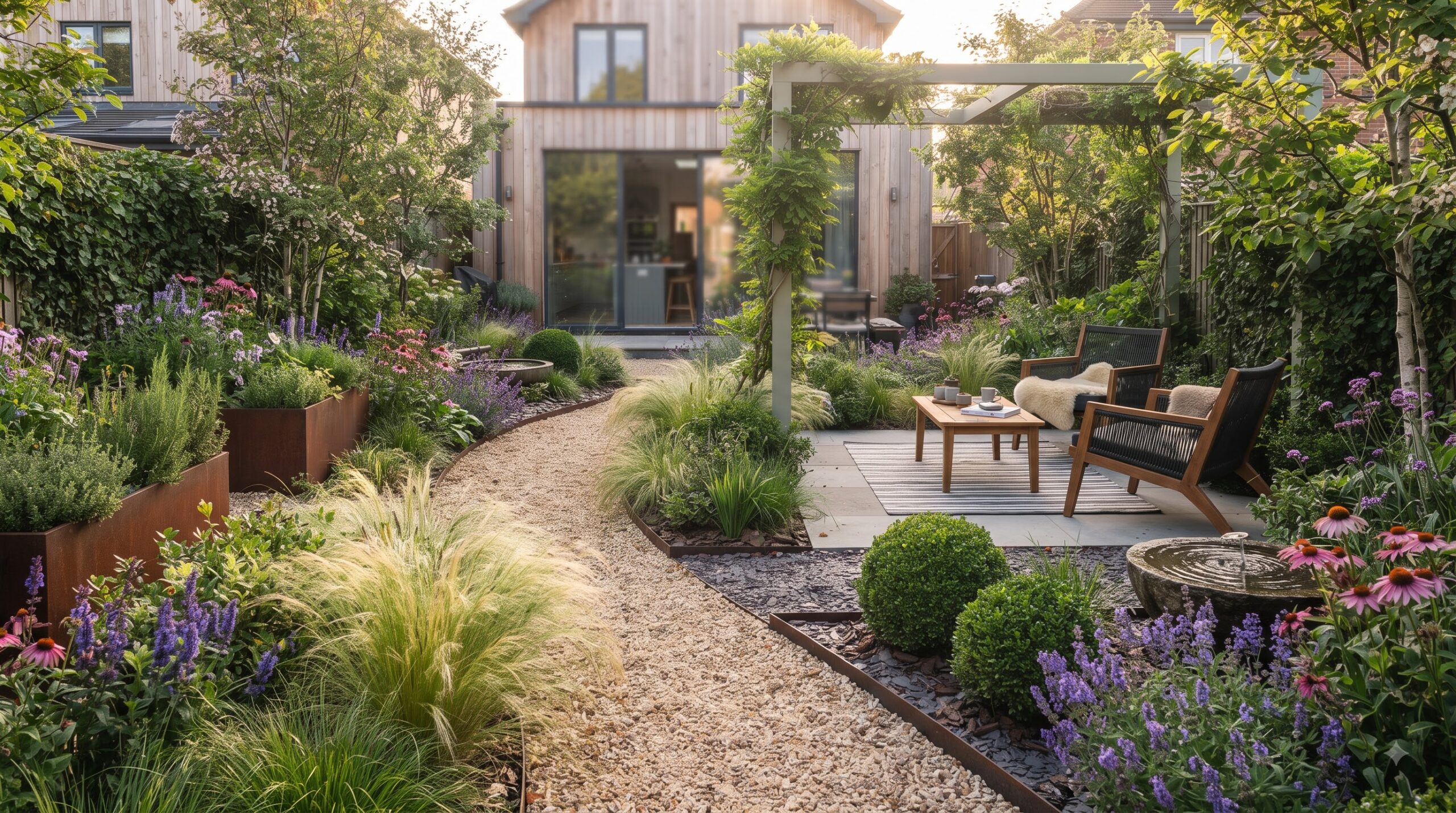
A beautiful garden should give you somewhere to relax—not another weekend job.
Yet traditional gardens can demand hours of mowing, weeding, watering, pruning and replanting. The good news is that you don’t have to choose between a garden that looks stunning and one that is easy to maintain.
The real secret is low maintenance garden design. Instead of creating a landscape that needs constant attention, you can make smart decisions about the layout, soil, plants and watering system from the beginning.
The result is a garden that stays attractive with far less work.
1. Start With the Right Garden Design
One of the biggest mistakes in garden planning is filling every available space with plants or maintaining a large area of thirsty lawn.
A low maintenance garden starts with reducing the features that create the most work.
Reduce the lawn
- Lawns can require regular mowing, feeding, watering and seasonal care.
- If you don’t need a large area for children, pets or recreation, consider replacing part of it with:
- paving
- gravel
- planting beds
- a seating area
A patio or gravel nook can also make the garden more useful.
Surround an outdoor dining area, fire pit or seating space with attractive planting and you immediately create a defined garden zone without adding a lot of maintenance.
Try a gravel garden
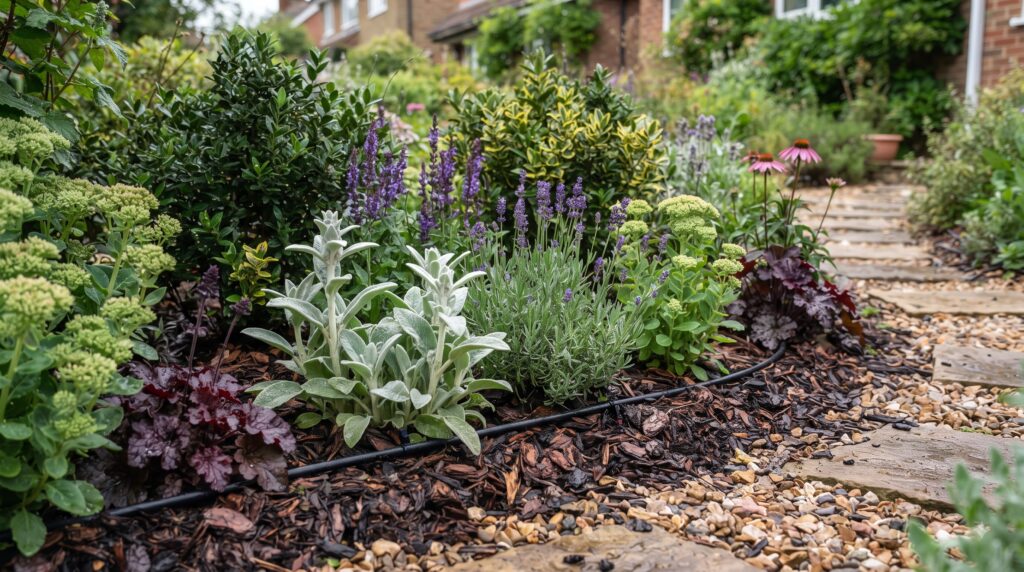
Gravel is particularly useful for creating an informal, Mediterranean-inspired landscape.
It provides an attractive backdrop for architectural plants while helping reduce exposed soil and weed growth.
Choose a suitable gravel size for comfortable walking and combine it with plants that prefer well-drained conditions.
Avoid relying on permanent synthetic landscape fabric wherever possible.
Instead, good soil preparation, dense planting and appropriate organic or biodegradable materials can help manage weeds while allowing the garden to develop naturally.
Consider raised beds
Raised beds can make planting and maintenance easier, particularly where drainage is poor.
They can also reduce the amount of bending required for routine gardening.
The key principle is simple: make the garden easier to use before you start planting it.
2. Build Healthy Soil With No-Dig Gardening
Healthy soil is one of the foundations of an easy-care garden.
Instead of repeatedly digging and disturbing the ground, consider a no-dig approach.
The Royal Horticultural Society recommends no-dig gardening as a way to reduce cultivation while improving soil health and supporting soil organisms.
A basic no-dig bed can be surprisingly simple.
How to create a no-dig bed
| Step | What to do |
|---|---|
| 1 | Cover existing grass or weeds. Lay overlapping sheets of non-shiny, unprinted cardboard over the area. |
| 2 | Add organic matter. Cover the cardboard with roughly 10–15cm of well-rotted compost or other suitable organic matter. |
| 3 | Plant into the new surface. Once the bed is prepared, plants can be planted directly into the mulch layer. |
The source material recommends this approach because it suppresses existing vegetation while allowing roots to eventually reach the undisturbed soil underneath.
Don’t underestimate mulch
Mulch is one of the easiest ways to reduce garden chores.
A good organic mulch can help:
- suppress weeds
- reduce evaporation
- protect roots
- add organic matter to the soil as it breaks down
The RHS also notes that mulching can reduce the time spent watering and weeding.
For established beds, an annual layer of around 5cm is a useful starting point, depending on the material and planting situation.
Think of mulch as your garden’s maintenance assistant: it keeps doing its job while you are doing something else.
3. Choose Plants That Actually Suit Your Garden
No plant is completely maintenance-free.
However, the right plants can dramatically reduce the amount of work required.
The biggest mistake is choosing plants because they look good in a photograph without considering your soil, sunlight, climate or available moisture.
Instead, choose plants that naturally thrive in your conditions.
Use hydrozoning
Hydrozoning means grouping plants according to their water requirements.
- Put plants with higher water needs together.
- Give drought-tolerant plants their own zone.
This makes irrigation more efficient and prevents you from treating every plant as though it has identical needs.
The EPA also recommends grouping plants with similar water requirements into irrigation zones as part of water-smart landscaping.
Evergreen shrubs
Evergreen shrubs can provide the structural backbone of a low-maintenance garden because they retain foliage throughout the year.
Depending on your climate and growing conditions, examples include:
- Sweet box (Sarcococca)
- Fatsia japonica
- Dwarf mountain pine (Pinus mugo)
- Pittosporum
- Skimmia japonica
Always check mature size before planting.
A shrub that eventually outgrows its space can turn into a pruning problem.
Hardy perennials
Long-lived perennials are another excellent choice because they return year after year instead of requiring seasonal replacement.
The source highlights varieties including:
- Salvia ‘Caradonna’
- Geranium ‘Rozanne’
- Geranium macrorrhizum
- Geum ‘Totally Tangerine’
- Allium ‘Serendipity’
- Nepeta ‘Little Titch’
Ground-covering plants can be especially useful because dense foliage shades the soil and leaves fewer opportunities for weeds to establish.
4. Replace the Garden Hose With Smarter Watering
Watering can become one of the most repetitive garden chores, particularly during hot weather.
A timed drip irrigation system can remove much of this work by delivering water directly to the root zone instead of spraying the entire garden.
The source recommends:
- placing drip lines beneath mulch
- using a timer to automate watering
Better still, modern irrigation controllers can use weather or soil-moisture information to adjust watering.
The EPA says soil-moisture controllers can override scheduled irrigation when plants don’t need additional water.
This is particularly useful for gardens containing different planting zones.
Instead of watering everything on the same schedule, give each zone the amount of water it actually needs.
And remember: newly planted gardens generally require more attention while plants establish.
Once roots are well established, appropriately selected plants should need considerably less supplemental watering.
5. Make Maintenance Easy When You Do Need It
Even the best low-maintenance garden isn’t completely maintenance-free.
There will still be occasional:
- pruning
- planting
- deadheading
- leaf clearing
- spot weeding
The trick is to make these jobs quick.
Keep a small set of quality tools somewhere accessible.
| Tool | Use |
|---|---|
| Sharp pair of bypass pruners | Routine jobs |
| Soil knife or hori hori | Routine jobs |
| Gloves | Routine jobs |
| Lightweight weeding hoe | Routine jobs |
| Long-handled tools | Reduce bending when dealing with weeds |
If you grow plants in containers, choose fewer large containers rather than lots of tiny pots.
Larger containers hold more growing medium and generally dry out more slowly, reducing how often they need watering.
The Low-Maintenance Garden Formula
A truly easy-care garden isn’t created by simply buying “low-maintenance plants.”
It is created by combining several smart decisions:
| Smart decision | Result |
|---|---|
| Less lawn | Less work |
| Better soil | Less work |
| Mulch | Less work |
| Climate-suitable plants | Less work |
| Hydrozoning | Less work |
| Efficient irrigation | Less work |
| Sensible garden layout | Less work |
Less lawn + better soil + mulch + climate-suitable plants + hydrozoning + efficient irrigation + sensible garden layout = less work.
The most important lesson is that maintenance should be designed out wherever possible.
The RHS similarly points out that there is no such thing as a completely maintenance-free garden, but many traditional gardening tasks have lower-input alternatives.
So don’t aim for a garden that requires absolutely no work.
Aim for one where the work is small, predictable and worthwhile.
Once the garden is established, your weekends can be spent enjoying the space rather than constantly trying to keep it under control.
Add a comfortable chair, outdoor table or hammock, and you’ve completed the final step: creating a garden that is designed for living in—not working in.